Vertical Slice Architecture in ASP.NET Core Web API for Claude Code
Vladyslav Furdak
Senior Software Engineer & Microsoft MVP
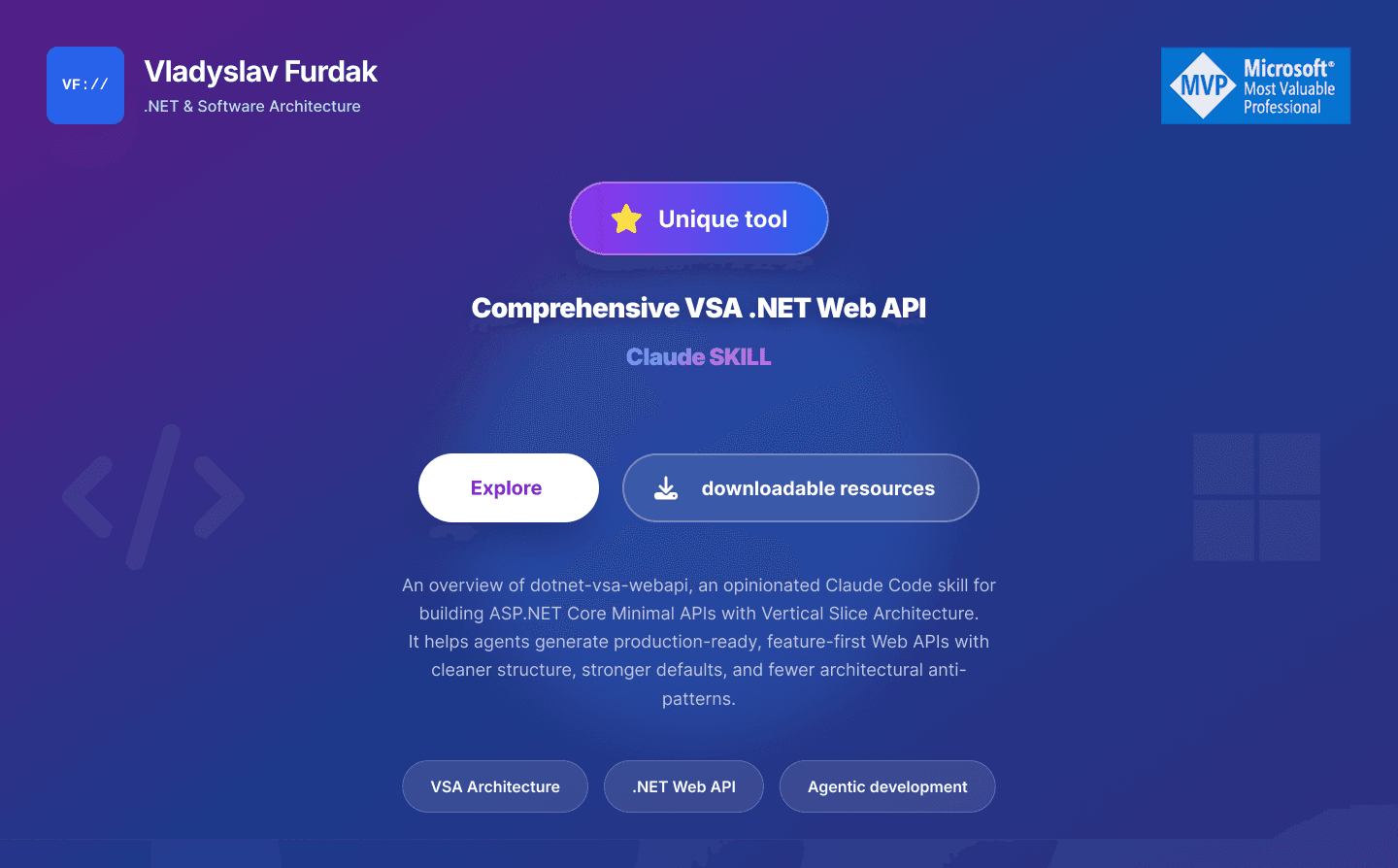
Vertical Slice Architecture is gaining traction as a practical alternative to layered and Clean Architecture approaches for building .NET Web APIs. In this article, we explore dotnet-vsa-webapi — an opinionated Claude Code skill that helps AI agents scaffold, generate, and review ASP.NET Core Minimal API projects using a feature-first, vertical-slice structure.
Overview of dotnet-vsa-webapi architecture skill
What skills are in Claude Code, and how to connect them
Skills in Claude Code are extensions with instructions and supporting files that give the agent specialized ways of working.
A skill usually consists of a folder containing SKILL.md:
Metadata is defined at the beginning.
The working rules are described after that.
Additional templates, examples, and reference files can be included when needed.
How to connect a skill
There are several main ways:
For personal use — place the skill in:
~/.claude/skills/<skill-name>/SKILL.md
At the project level — place the skill in:
.claude/skills/<skill-name>/SKILL.md
Via a plugin — install a ready-made package from the marketplace
How Claude uses skills
Claude can:
pick up a skill automatically if its description matches the task;
invoke it manually via a slash command.
Usually:
name in SKILL.md becomes the slash command;
description helps Claude understand when to apply that skill.
Against this backdrop, dotnet-vsa-webapi It is interesting because it is not a “small command,” but a full architectural playbook for Claude Code.
Just attach skill files to your LLM context windows, ask "use dotnet-vsa-webapi skill" and put your detailed requirements
What this skill is and how to use it
dotnet-vsa-webapi is a skill for designing, generating, refactoring, and reviewing ASP.NET Core Minimal API projects based on:
Vertical Slice Architecture
feature-first structure
Clean Architecture boundaries within each slice
FluentValidation
Result-based flow
strongly typed options
Serilog
production-ready practices
What is it good for
This skill is useful when you need to:
create a new .NET Web API;
Add a new slice;
migrate a project from a layered architecture to vertical slices;
perform an architectural review;
configure Aspire;
Make the solution layout cleaner and more structured.
How it is used
The skill gives the agent a clear workflow:
First, inspect the current shape of the repository.
Then determine the type of task.
After that, make the smallest coherent change.
Keep endpoints thin.
Move logic into request-specific handlers, not into general god services.
So this is not just a skill that says “generate an endpoint,” but a way to make the agent operate within a specific architectural model.
Why is it a good fit for starting new projects
The main advantage of dotnet-vsa-webapi It immediately establishes strong production-oriented defaults.
What is included in the baseline
For new projects, the skill steers toward:
.NET Aspire
AppHost for local orchestration
ServiceDefaults
.slnx
Central Package Management
a real PostgreSQL database
FluentValidation
Serilog
OpenAPI + Scalar
OpenTelemetry
Health probes
Docker/Kubernetes-ready setup
Why this matters
Very often, new projects start with a bad pattern:
“Let’s throw something together quickly for now.”;
“We’ll add infrastructure and production practices later.”
The problem is that “later” usually never comes.
dotnet-vsa-webapi removes this trap because it:
builds the project around real infrastructure from the start;
does not postpone observability;
does not postpone health checks;
does not postpone using a real database.
Why it forbids UseInMemoryDatabase
The skill explicitly and strongly advises against using UseInMemoryDatabase for new projects, because that provider:
does not reflect real transactions;
does not expose constraints;
does not reproduce migration behavior;
hides SQL-specific details;
creates a false sense of readiness.
Instead, it recommends using PostgreSQL via Aspire right away.
What constraints, best practices, and anti-patterns are built into it
At the core of the skill is a simple rule:
Every HTTP request is a separate vertical slice.
And the entire codebase should be organized:
by features,
not by technical layers.
Key architectural principles
The skill promotes these practices:
one request = one slice
feature-first folders
thin endpoints
validation located next to the slice
direct DbContext usage for EF Core
local SQL inside the slice when using Dapper
shared code is earned, not created upfront
interfaces only at meaningful seams
Exceptions only for unexpected errors
What an endpoint should look like
The ideal flow, according to the skill, is:
Accept the request.
Validate it.
Call the handler.
Return the HTTP result.
No unnecessary magic and no heavy orchestration code inside the endpoint.
Which anti-patterns does it cut off
By default, the skill discourages:
MediatR
AutoMapper
generic repository over EF Core
fat endpoints
god-services
service locator
speculative interfaces
exception-driven business flow
giant shared folders
reflection-heavy magic
Why do these restrictions exist
The reasoning behind these restrictions is very practical:
fewer unnecessary abstractions;
fewer layers for the sake of layers;
less magic;
more transparency;
more local changes;
better code readability.
In other words, the skill is not fighting libraries as such, but premature complexity.
Why does it work well for agentic development
For agentic development, dotnet-vsa-webapi It is especially good because it forces the agent to think in terms of use cases, not technical layers.
What it suggests is that instead of a layered structure
Instead of an approach like this:
Controllers/
Services/
Repositories/
The skill points toward something more like:
Features/Orders/CreateOrder/
Features/Orders/GetOrder/
Features/Orders/CancelOrder/
What lives inside a single slice
Usually, the following are kept together:
request DTO;
validator;
handler;
response;
endpoint.
Why is this convenient for an AI agent
This structure gives the agent several advantages:
It is easier to find the right place to make a change;
It is easier to add a new use case;
It is easier to make local changes;
It is easier to avoid touching the entire solution;
It is easier to maintain consistency across features;
It is easier to avoid creating shared abstractions “just in case.”
Why does the structure end up cleaner
The skill additionally forces the agent to:
First, inspect the current repository shape;
then make the smallest coherent change;
avoid rewriting half the project unnecessarily.
This is especially important in agentic development because it reduces a typical AI problem: when making one change, the tool also starts “improving” everything around it at the same time.
Vertical Slice Architecture vs Clean Architecture
Both Vertical Slice Architecture and Clean Architecture aim to keep .NET codebases maintainable, but they solve the problem differently.
Folder structure
Clean Architecture splits the solution into layers: Domain, Application, Infrastructure, and Presentation. A single feature touches all four projects. Vertical Slice Architecture groups everything by feature — request, validation, handler, and response live in one folder such as Features/Orders/CreateOrder/.
Dependency direction
In Clean Architecture, dependencies flow inward toward the domain, enforced by project references. In Vertical Slice Architecture, each slice is self-contained; cross-slice coupling is avoided, and shared code is extracted only when duplication is proven.
When to choose which
Clean Architecture is a good fit when your domain model is complex and reused across many entry points (APIs, message handlers, scheduled jobs). Vertical Slice Architecture shines when most logic is request-specific, the team values locality, and you want to avoid premature abstractions.
dotnet-vsa-webapi leans firmly into the vertical-slice camp and adds opinionated production defaults on top.
Frequently Asked Questions
What is Vertical Slice Architecture in .NET?
Vertical Slice Architecture organizes code by feature (use case) rather than by technical layer. Each HTTP request gets its own self-contained slice that includes the endpoint, request/response DTOs, validation, and handler — all in one folder.
How does dotnet-vsa-webapi differ from Clean Architecture templates?
Clean Architecture templates separate code into layers (Domain, Application, Infrastructure, Presentation). dotnet-vsa-webapi groups code by feature instead, keeping each slice independent. It also ships with production defaults like Aspire, Serilog, FluentValidation, and OpenTelemetry out of the box.
Can I use MediatR with Vertical Slice Architecture?
You can, but dotnet-vsa-webapi deliberately avoids MediatR. The skill treats it as an unnecessary abstraction for most Web API scenarios — direct handler calls inside a slice are simpler and easier to trace.
Is Vertical Slice Architecture suitable for large .NET projects?
Yes. Because each feature is isolated in its own slice, teams can work on different features without merge conflicts. Shared code is introduced only when duplication is proven, which keeps the codebase maintainable as it grows.
How do I migrate from a layered architecture to vertical slices?
Start by picking one endpoint and moving its controller action, service logic, and validation into a single feature folder. Repeat slice by slice. dotnet-vsa-webapi can guide the agent through this migration incrementally.
Conclusion
dotnet-vsa-webapi is not just a skill that says “generate an ASP.NET endpoint,” but a tightly packaged architectural stance for Claude Code.
Why it is good
It provides a strong baseline for new projects;
It immediately pulls in production-friendly defaults;
It limits harmful patterns;
It helps keep architecture under control;
It creates a predictable feature-first structure;
it is well suited for agentic development.
What makes it specific
It is highly opinionated;
It is not universal for every .NET scenario;
Its value lies precisely in the fact that it imposes strict rules.
Brief takeaway
If you need not just an “ASP.NET code generator,” but a skill that helps an agent write code within a clear, mature, and evolution-friendly architecture, then dotnet-vsa-webapi Looks like a very strong option.
Senior Software Engineer & Microsoft MVP with 15+ years building scalable backend systems. Founder of Ukraine's largest .NET community. Writes about clean architecture, design patterns, EF Core, Azure, and engineering career growth.

 Front-end